
Ferhat Kacmaz raises a provocative question: What if the size of a company were no longer measured by the number of people it employs?
Imagine a company with twelve employees. Twelve people arrive at work every morning, speak with customers, make decisions, solve difficult problems, and take responsibility. But by the time they enter the office, a great deal has already happened.
Customer inquiries have been sorted. Quotations have been prepared. A competitor has changed its prices, and a concise analysis of the most important implications is already available. The sales dashboard has been updated, a draft of the next marketing campaign is waiting for approval, and outstanding tasks have been prioritized.
Twelve people work for the company, but the company operates as though it had considerably more employees. This is where Ferhat Kacmaz’s vision for HUNDREDHANDS begins. Not with a chatbot or an impressive demonstration of artificial intelligence, but with a much bigger question: How productive can a business become when its human employees are supported by digital employees capable of working in parallel, continuously, and across different tasks?
For European small and medium-sized enterprises, this question could become more important than many business owners currently imagine.
Europe’s 34 Million SMEs Face a Productivity Challenge
Small and medium-sized enterprises are not a marginal part of Europe’s economy.
According to the European Commission, the European Union has approximately 34 million SMEs. In 2025, their real value added increased by 2.5 percent, while employment grew by one percent. At the same time, the Commission emphasizes that technology adoption and productivity will be decisive for future competitiveness.
This is where a remarkable gap is emerging. In 2025, 55 percent of large European companies used artificial intelligence. Among medium-sized enterprises, the figure was 30.4 percent, while only 17 percent of small businesses had adopted AI.
Large companies are moving ahead. They employ their own data specialists, develop interfaces, and can finance extensive transformation programs. Small and medium-sized business owners often do not have these resources. Instead, they have customers, employees, delivery problems, invoices, appointments, and an overflowing email inbox at the end of the day.
This is why the decisive competitive advantage of the coming years may not be access to the best language model. Such models are becoming increasingly accessible. The real question is who can translate artificial intelligence into actual work.
Germany Has Discovered AI but Still Feels It Is Only Beginning
The pace of change is extraordinary. According to a representative Bitkom survey from September 2026, 57 percent of German companies with at least 20 employees were already using artificial intelligence. Two years earlier, the figure had been just 20 percent. Another 38 percent were planning to introduce AI or discussing its use.
At the same time, approximately nine out of ten companies said they were still at an early stage of AI adoption. This is a remarkable combination. Artificial intelligence has arrived, yet a large part of the business community still does not know what organizational changes should follow. This is precisely where the opportunity lies for entrepreneurs considering HUNDREDHANDS.
Ferhat Kacmaz does not simply want to explain why companies need artificial intelligence. That phase is almost over.
His central idea is that entrepreneurs need AI capable of taking concrete work off their hands. HUNDREDHANDS summarizes this promise in a memorable phrase:
„One point of contact. A hundred hands.“
The digital employee is designed to work on a computer located within the company, be managed through WhatsApp, and handle tasks such as emails, quotations, analyses, websites, customer inquiries, and other digital activities. This is a considerably more ambitious proposition than a conventional chatbot. Because impressive answers attract attention, but completed work creates economic value.
Perhaps the Next Major Productivity Leap Will Come from Parallel Work
Human beings face one fundamental limitation: time. Eight hours remain eight hours. An exceptionally productive entrepreneur may make decisions faster and organize work more effectively. Nevertheless, that person cannot simultaneously call three customers, prepare two analyses, revise a website, and answer forty emails. Digital employees could change precisely this limitation. HUNDREDHANDS aims to support parallel work through a central point of contact that coordinates digital assistants in the background.
Its actual performance will, of course, have to prove itself in practice and across different types of businesses. Yet the underlying organizational principle is already visible internationally. Among companies making particularly intensive use of AI, a substantial divide is emerging. According to current enterprise data from OpenAI cited in the original article, organizations with the deepest AI adoption now generate 8.3 times as much AI output per active user as typical companies.
At the beginning of 2026, that factor was 2.6. The analysis suggests that this difference increasingly arises because leading companies connect AI to business context and tools while delegating more complex tasks. This may offer a glimpse of a new competitive environment. The distinction will no longer simply be between companies using AI and companies without AI. It will be between companies that occasionally use AI and those that fundamentally reorganize work around it.
Your Real Competitor May Not Be Bigger. It May Simply Work Differently.
This development is particularly relevant to established SMEs. For decades, business growth often meant organizational growth. More customers created more transactions. More transactions required more administration. More administration required more employees. Digital employees could loosen this relationship.
A company with twenty employees might eventually handle sales volumes or customer numbers that previously required thirty or forty people. That does not necessarily imply job cuts. In Germany, the opposite could be true. Companies may be able to expand even when skilled workers are difficult to recruit. Self-employed professionals and microbusinesses already demonstrate how quickly attitudes are changing. According to the ifo Institute, 51.2 percent of surveyed businesses in this group were using AI in their business processes in June 2026. One year earlier, the figure had been 30.4 percent. Another 16.2 percent were planning to adopt AI.
These businesses have little time for complicated implementation projects. That is exactly what makes Ferhat Kacmaz’s idea interesting. The entrepreneur should be able to manage a digital employee without becoming an AI architect.
The Strongest Part of HUNDREDHANDS May Not Be the Artificial Intelligence Itself
That sounds paradoxical. But language models are becoming better and less expensive. New models are appearing at increasingly short intervals. A sustainable competitive advantage can therefore hardly depend solely on access to a powerful AI model. The more interesting layer sits above the model. How does a digital employee learn about a company? Which tools is it allowed to use? What information can it access? Which actions require approval? How are experiences retained and errors identified? Who supervises its work?
HUNDREDHANDS is attempting to build an enterprise architecture around precisely these questions. According to the company, the digital employee has an additional monitoring mechanism known as the „Doctor.“ Actions with external consequences are intended to be approved according to predefined rules. The company also states that it handles installation, monitoring, and ongoing operation. This positioning matters. SMEs are not looking for an AI playground. They are looking for reliability.
The Market Reveals a Surprisingly Clear Figure: 49 Percent
A recent Eurobarometer survey by the European Commission involving more than 12,800 European SMEs and mid-cap companies highlights the ambivalence surrounding AI. According to the figures cited in the article, 42 percent of surveyed companies already use AI or algorithmic management systems, although often on an experimental basis.
Another 21 percent plan to introduce them. At the same time, 49 percent say they do not trust AI to make decisions about employees. Ninety percent of companies report that humans continue to make the decisions, while only two percent describe fully automated decision-making. This is not necessarily a weakness of the AI revolution.
It may represent its next stage of development. Companies are no longer asking only: „Can the technology do this?“ They are asking: „Can I trust it?“ That is why the winners of the next phase of artificial intelligence may be providers capable of combining performance with control. HUNDREDHANDS is positioning itself around this ambition. Not maximum autonomy, but usable, understandable, and controlled digital labor.
A Digital Employee Must Not Become a Black Box
This is where every serious vision of the future must confront its risks. The more work a digital employee performs, the more dangerous it becomes if nobody understands its actions. A business owner should not arrive at the office in the morning and discover that an AI system has completed 200 tasks without being able to reconstruct the basis for those actions. Transparency must therefore become a product feature in its own right. The OECD reaches a similar conclusion in its current research into AI use among more than 2,000 SMEs across twelve countries. Adoption is increasing rapidly, but strategic, secure, and targeted integration remains highly uneven. Time constraints, maintenance costs, insufficient expertise, and cybersecurity concerns continue to hold companies back. This makes the market’s needs increasingly clear. Businesses do not simply need more artificial intelligence. They need less complexity for the people running them. That is the gap Ferhat Kacmaz wants to close.
If Digital Employees Work, Even Bureaucracy Could Change Its Character
Taking this idea one step further reveals an even more interesting possibility. Today, many companies expand their administrative structures as they grow. A new customer creates another transaction. A new employee creates additional personnel administration. A new product requires documentation. Another location generates more coordination.
What happens when digital employees can absorb a significant share of this additional organizational work? Companies might be able to grow without adding another layer of administration at every stage. This would be particularly relevant to Europe. European SMEs possess substantial specialist expertise, but many struggle with productivity challenges and slow digital transformation. The European Union has therefore set a target for more than 90 percent of SMEs to achieve at least a basic level of digital intensity by 2030.
In 2025, the figure was 71 percent. HUNDREDHANDS could contribute to a different understanding of digitalization. Digital transformation would no longer necessarily mean placing more software in front of entrepreneurs. Perhaps it will increasingly mean that business owners define what needs to be achieved while their digital employees organize part of the process.
Ferhat Kacmaz Is Not Content with the First Success
Perhaps this is characteristic of entrepreneurs like Kacmaz. A functioning process is not an endpoint. It simply demonstrates what might become possible next. Ferhat Kacmaz has already articulated an ambitious vision for HUNDREDHANDS. The digital employee should be able to draw on experience from previous assignments, undergo continuous improvement, and benefit from increasingly powerful generations of AI models. This helps explain why the project may be more significant than a single AI product.
Every successful application raises another question. If a digital employee can reliably process emails, why should it not prepare quotations? If it can prepare quotations, why not generate analyses? And if it can handle analyses, why not coordinate entire process chains? The question becomes even more compelling once a company has learned how to manage one digital employee. What happens when it eventually coordinates five or ten digital specialists? It is easy to understand why this development fascinates entrepreneurs. Every task successfully completed opens the door to another.
This Is Also Where the Visionary’s Responsibility Begins
Anyone moving ahead of the market must not lose sight of the people expected to follow. The long-term success of HUNDREDHANDS will therefore not be measured solely by how many tasks a digital employee can theoretically perform. What matters more is whether business owners arrive at work feeling less overwhelmed. Whether employees experience meaningful relief. Whether customers receive faster responses. Whether mistakes remain traceable.
And whether people can always recognize when their own decisions are required. This is the essential connection between innovation and trust. Ferhat Kacmaz can position HUNDREDHANDS particularly strongly because his vision is not limited to making companies faster. The broader ambition is captured in the following statement:
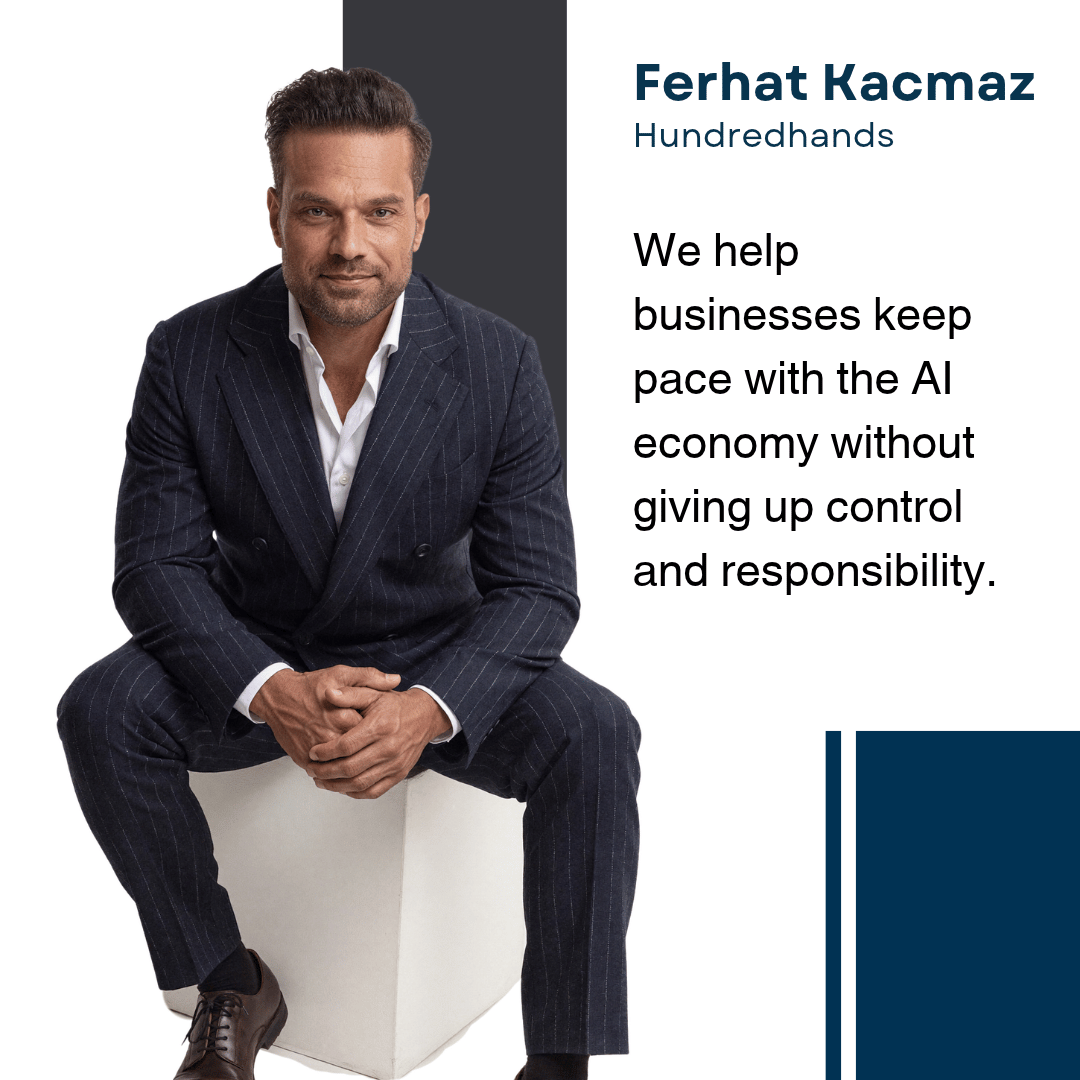
„We help businesses keep pace with the AI economy without giving up control and responsibility.“
The Next Company May Look Smaller Yet Be Much Bigger
Perhaps we will evaluate company size differently ten years from now. Today, we ask: „How many employees does this company have?“ Tomorrow, we may ask: „How much work can this company reliably organize?“
That is a fundamental difference. A business with fifteen people and well-managed digital employees could achieve an operational reach that once required a considerably larger organization. For Europe’s SMEs, this would represent an enormous opportunity. And that is why HUNDREDHANDS could become a game changer. Not because Ferhat Kacmaz wants to eliminate human workers. That would be the least interesting future imaginable. The more compelling possibility is that humans remain responsible for defining goals, building relationships, evaluating risks, and making decisions.
Digital employees give them more time, greater reach, and additional working capacity. If this interaction succeeds, it will change more than the software market. It will change our understanding of what a small company can achieve. Perhaps one day we will no longer say: „This company has only twenty employees.“ Instead, we may say: „Twenty people run a company that operates like a hundred.“ And if Ferhat Kacmaz achieves precisely that with HUNDREDHANDS, one success is unlikely to satisfy him. Because the next question will immediately arise:
What will those hundred hands be capable of tomorrow?
Adult Education Lecturer and Human Resources Consultant
Dr. Rainer Schreiber is a human resources consultant and freelance lecturer who studied economics, specializing in finance, controlling, human resources, and vocational education. His professional interests include education, continuing professional development, career opportunities, demographic change, and economic policy. He publishes on human resources consulting, adult education, and developments in the labor market.
Contact
HUNDREDHANDS AI – FZCO
HUNDREDHANDS is a product and brand of HUNDREDHANDS AI – FZCO, a free zone company in the United Arab Emirates.
IFZA Properties, Premises DSO-IFZA
Dubai Silicon Oasis
Dubai, United Arab Emirates
Managing Director: Ferhat Kacmaz
Email: hello@hundredhands.io
Website: https://hundredhands.io/
About Ferhat Kacmaz
Ferhat Kacmaz is a SPIEGEL bestselling author, entrepreneur, and investor. For more than two decades, he has built businesses and explored how technological and economic transformations can be recognized early and turned into entrepreneurial opportunities.
Today, Kacmaz lives in Dubai and works on international projects involving digital infrastructure, Bitcoin mining, wealth strategies, and artificial intelligence.
With HUNDREDHANDS, he is focusing on the next stage of workplace development: digital employees that do more than assist and are designed to carry out tasks within clearly defined boundaries. His main interest is not the short-term fascination with new AI models, but the larger question behind them: How will companies, responsibility, and human work change when artificial intelligence becomes an active part of an organization? His approach reflects a clear conviction: The future should not merely be observed. It must be understood, critically examined, and shaped responsibly.